Rules
You don’t need to learn these before playing! Feel free to read them if you’d like, but these are mostly here for my reference.
Changelog
06/25/26: Created this website! As we decide on rules changes, I'll document them here.
Table of Contents
- Rules
0. Character Creation
I'll bring character sheets for everyone, but if you need to replace yours: print off this character sheet to record your details.
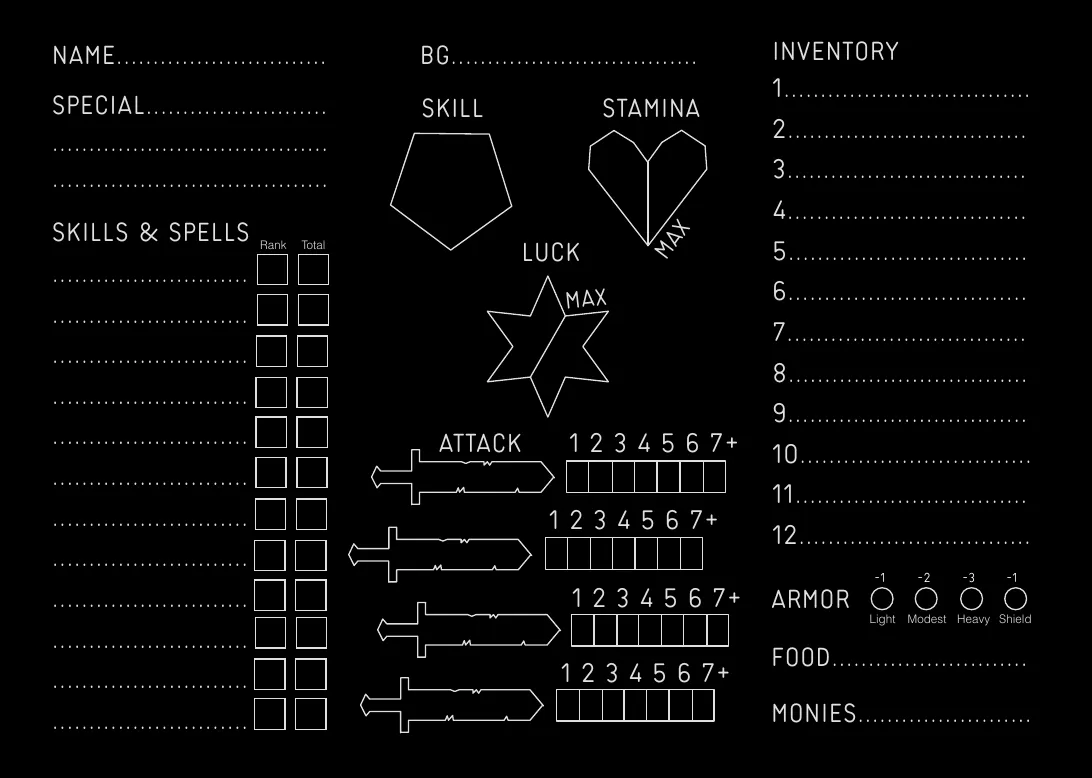
A preview of the character sheet that's easier on the eyes.
Follow these steps:
Roll 1d3+3 to determine Skill.
Roll 2d6+12 to determine Stamina.
Roll 1d6+6 to determine Luck.
Record Baseline Possessions that every new character starts with: 2d6 Silver Pence, a Knife, a Lantern & Flask of Oil, a Rucksack, 6 Provisions.
Pick a Background from the list and record your new possessions and advanced skills.
Backgrounds are everything your character was before you got hold of them. They provide you with Skills, Possessions, and other Special benefits where noted. Slide into the role and make it your own.
1. Rolling the Dice
There is only one die type used in Troika!, that being the d6. This can be used as a d3, d6, d66, d666, and so on. To roll a d3 just roll a d6 and halve it, rounding up. To roll a d66, d666, or more just roll a d6 as many times, in order, as there are 6s. So a d66 would be a d6 followed by another d6 (e.g. I roll a 1 then roll a 4 thus making a roll of 14). To do most actions you’ll be required to roll 2d6, adding them together, as a Roll Under or a Roll Versus.
1.1 Roll Under
Rolling Under is the throwing of 2d6 with the intention of scoring equal to or under a number. This will mainly be used in unopposed situations like climbing a wall or casting a Spell. Rolling two 6s always results in failure.
1.2 Roll Versus
Roll Versus, mostly used for combat or other contests, occurs when two opponents each roll 2d6 and add any applicable bonuses, then compare results, the higher total winning. In a duel you might be rolling 2d6 and adding your Sword Fighting total, looking to beat your opponent who is doing similar.
2. Advanced Skills & Spells
Characters have a variety of Advanced Skills & Spells granted them by their Background. The number given in the Background plus their Skill is referred to as their Skill Total. Write this on the character sheet.
2.1 Testing Advanced Skills & Spells
Most Tests of Advanced Skills & Spells are Roll Under (12 & 14). When you successfully Test an Advanced Skill or Spell, put a tick next to it on your character sheet. These are used to Get Better (11.1).
3. Luck
Of all the numbers on your character sheet Luck is likely to fluctuate the most. This number represents your character’s fortune and intuition, tested whenever fate swipes at them. When this happens the GM will ask you to Test your Luck or suffer the consequences.
3.1 Testing your Luck
Roll equal to or less than your current Luck score. Every time you Test your Luck, reduce your current Luck score by 1 regardless of whether the Test was successful or not. Testing your Luck is optional; you may always refuse to roll and instead accept your fate. The GM is not obliged to give you details of the consequences if they are not already obvious.
3.2 Gaining and Losing Luck
For every 8 hours rest you may regain 2d6 Luck. Luck may not exceed the starting value rolled at character creation save for exceptional situations. Running out of Luck inflicts no special penalty.
3.3 Use of Luck in Combat
In the case of a tie the character may Test their Luck to break it in their favour. When a character successfully hits an opponent, but before rolling for Damage, they may decide to Test their Luck and, if successful, may add 2 to their Damage Roll.
3.4 OPTIONAL: Luck Versus Death
If you find your games are too fatal and that the turnover of characters is too much to bear the GM might optionally allow characters who have died to Test their Luck and, instead of dying, be incapacitated, wounded, or saved by some bizarre twist of fate.
4. Stamina
4.1 Running Out of Stamina
When reduced to 0 Stamina you are in danger of dying and must be healed in order to survive. If this is during an Initiative Round the next time the End of the Round Token is drawn you die. If this happens out of Initiative your friends have one opportunity to Heal you (restoring you to 1 Stamina) or else you are dead.
4.2 Healing
You regain 2d6 Stamina if you sleep for 8 hours. You may also eat a Provision to regain 1d6 Stamina. A maximum of 3 Provisions per day will provide healing benefits. There may be other forms of healing available at your GM’s discretion such as visiting bath houses or drinking potions. You may never have more Stamina than your starting total.
4.3 Negative Stamina
If you ever go below 0 Stamina you are dead.
4.4 Death
You may immediately make a new character while others mourn your loss and fight over your possessions. This new character starts exactly according to the rules found at the beginning of this book.
5. Initiative
5.1 Assemble the Stack
During combat or at other times where it is important to know who goes first you will need to assemble the Initiative Stack. To do this get a container and a selection of coloured dice or other convenient markers (consider cards, poker chips, and so on).
- Assign each character 2 Tokens of a single color.
- Add Tokens to the Stack for the enemies equal to their total combined Initiative (if you have 8 Lizard-Men (Initiative 2) you would add 16 tokens to the Stack).
- Add 1 Token of a distinct colour to the Stack. This Token signifies the End of the Round.
- OPTIONAL: Enemy Initiative Limit. It is very likely that sometimes the characters’ enemies will grossly outnumber them and make it very hard for them to act. The GM may optionally limit the number of Enemy Initiative Tokens placed in the Stack to double that which the characters contribute. So if a party of 5 (10 Initiative Tokens in total) is attacked by fifty goblins (50 Initiative Tokens) the goblins will only contribute 20 Tokens to the Stack. Bear in mind that the GM should feel free to balance Initiative Stacks as it seems appropriate.
5.2 Using the Stack
The GM will remove a Token from the Stack at random, the colour or design of which will determine who holds the Initiative and takes a Turn. Consider giving a copy of their Token to each player so that everyone remembers which colour or design is theirs.
5.3 End of the Round
If the End of the Round Token is drawn all Tokens, including the End of the Round Token, are put back in the Stack. Remove Tokens contributed by dead characters and enemies, resolve any per Round or end of Round activities such as magic effects, Drowning (7.9), fire, poison, or bleeding, then draw another Token and carry on.
5.4 Henchman
Hired help that are willing to engage in combat each provide 1 Initiative Token to the Stack. Henchmen share a single colour Token and when a henchman Token is drawn the GM determines who acts and what they do. The GM should take the wishes of the players under advisement but act in the best interests of the henchman.
5.5 Enemies
All enemies contribute a varying number of Initiative Tokens to the Initiative Stack according to their combined Initiative and share the same colour or design. When drawing an enemy Initiative Token the GM can declare that any enemy is acting, including an enemy who has acted previously this Round. Obviously this can be abused for mechanical gain on the GM’s part though that would be entirely to the detriment of the game and is discouraged. Apply Initiative Tokens as they make sense.
5.6 Rationale
The random Turn length adds a degree of uncertainty where you never know how much time you have left. When actions are not taking place it represents hesitation, panic, or other incidental delays that can happen in a tense encounter where every second counts. The goblins have few Tokens because they are cowardly, not because they are slow; the dragon has many because it knows exactly what it wants, not because it is fast.
6. Actions
When you hold the Initiative you may take a Turn and can generally perform one action. The following list is not exhaustive and the GM is encouraged to interpret player intentions as best they can.
6.1 Hit Someone
To stab, bludgeon, or otherwise physically interfere with someone, Roll (2d6+Skill+Advanced Skill) Versus an opponent doing the same thing. The winner Rolls for Damage and the loser deducts the number generated by the Damage Roll from their Stamina. Note that either party in any exchange can potentially win. In a tie both parties have avoided hurting each other. Also note that this means you can potentially hit an unlimited number of people in a Round but may only Initiate once per Turn.
6.2 Shoot Someone
Shooting an opponent is resolved by Rolling Versus their Skill or appropriate evasive Advanced Skill such as Shield or Dodge.
6.2.1 Shooting Into Melee
When shooting into melee on a successful hit assign a number to every individual involved and roll a die. If their number comes up they receive the Damage.
6.2.2 Aim
On your Turn you may decide to take Aim with your ranged Weapon. To do so hold onto your Initiative Token. When your next Initiative Token is drawn you may roll twice and pick the best roll. If the End of the Round Token comes up and you haven’t used your Aim Token you may decide to hold onto it for the next Round.
6.3 Cast a Spell
Each Spell has its own instructions on how it should be used but in general you will need to spend a certain amount of Stamina and Roll Under or Roll Versus (for Spells that require you to touch an unwilling party, for instance) in order to create some kind of effect. Unless the Spell says otherwise it requires at least one hand free and the ability to speak. Roll on the Oops! Table if the result is a Fumble.
6.4 Delay
You may choose not to act when you hold Initiative. In that case put your Token back in the Stack.
6.5 Move
Every action is assumed to have a bit of movement involved. Anything less than 12 metres is folded into whatever else you might be doing. If you wish to chase after someone or perform some other involved locomotion then just spend a Turn doing it.
6.6 Retrieve an Item
If you need to get something out that you weren’t already holding in your hands roll 2d6 and score equal to or higher than its position on your Inventory list. If you succeed you can pull it out and do what you intended. Otherwise you spend your entire action finding it. Double 1s always indicate a failure. Retrieving an arrow counts as an item retrieval. Make sure they’re packed on top! See Sections 10.3 and 10.4.1 for more on Inventories.
6.7 Use an Item
If an item is in your hands you may use it however you like (6.6).
6.8 Grapple
Roll Versus your opponent’s Wrestling Skill. If you win you may either knock them to the ground or deal Damage as Unarmed and knock you both to the ground (from throwing or tackling them). On a Mighty Blow (7.4) you render them unconscious for 1d6 Rounds. If you fail to grapple them they may deal Damage to you as though they had attacked you normally whereas if you Fumble (7.5) they deal you a Mighty Blow.
7. Other Concerns
7.1 Cover
When attacking someone in cover they receive a bonus to their roll to not be hit. Consider a waist high bush to be +1 while a castle’s crenulations would be +6.
7.2 Enemies
Mechanically speaking, an opponent is typically reduced to three numbers: Skill, Stamina, and Initiative. Beyond this they may have an Advanced Skill or two or some peculiar special rules.
7.3 Hitting Someone Unawares
If your opponent is not aware of your presence your attack is a Roll Under rather than a Roll Versus (1.2), they may not attack back, and you may add 2 to your Damage Roll.
7.4 Mighty Blow
If you roll a double 6 while attacking you strike a Mighty Blow, win the exchange, and inflict Double Damage (8.1). If both parties strike a Mighty Blow a spectacular clinch is formed, shattering both Weapons (in the case of beastly claws, tentacles, and so on they will lose 1d6 Stamina instead).
7.5 Fumbles
A roll of double 1s in combat results in the roller losing the exchange and their opponent adding 1 to their Damage Roll. If both parties Fumble they each deal Damage to the other, adding 1 to their Damage Roll.
7.6 Shields
Shields reduce Damage Rolls by 1 to a minimum of 1.
7.7 Use of Multiple Weapons
When rolling Damage you may choose which Weapon to reference the Damage Roll against after rolling. You must be holding it in your hands or nearest approximations, obviously.
7.8 Falling Over
When on the floor you suffer -2 to all physical rolls against those standing, including Damage Rolls, and must spend a Turn getting to your feet.
7.8.1 Falling Too Far
When engaging in uncontrolled falls you lose 1d6 Stamina per 2 metres fallen when you land.
7.9 Drowning
When you fail a Swimming Test you begin to Drown and lose 1d6 Stamina. For each consecutive Swimming Test where you make no progress you roll an additional 1d6. So for instance your third failed Swimming roll in a row would lose you 3d6 Stamina. Once you lose all Stamina you have Drowned.
7.9.1 Fire, Poison, and Bleeding
Any ongoing debilitating effects should be treated similarly to Drowning. Unless you have a specific effect in mind have the victim lose 1d6 Stamina per Turn with it optionally becoming more severe unless they either pass a related Advanced Skill Test or successfully Test their Luck (or Skill for Enemies). Improvisation is strongly encouraged.
7.9.2 Degenerative Effects in Combat
Test for Drowning, fire, etc. only when the End of the Round Token is drawn.
7.10 Henchmen
Henchmen are created as you would a monster, with truncated abilities only covering their essence. They are their own people with their own motivations and are not just pieces of equipment. It is up to the GM and players to flesh them out or not as the case may be. Also see Section 5.4.
7.11 Time
There are two main units of time in the game: Turns and Rounds. A Turn is what someone does when they hold Initiative and is a few seconds long. A Round is the period between drawing successive End of the Round Tokens and is roughly equal to one minute.
8. Damage
When you win a Roll Versus an opponent in combat you inflict Damage. After successfully hitting someone roll d6 and consult the Damage Charts on the inside front cover of this book. Reference your Damage Roll across the top row and the Weapon down the side. The result is the Damage inflicted and is deducted from your opponent’s Stamina.
8.1 Double Damage
When striking a Mighty Blow (7.4) you double the amount of Stamina lost as a result of a Damage Roll.
8.2 Damage Modifiers
All modifiers that add bonuses to Damage will, unless otherwise specified, modify the roll of the die, not the actual Damage inflicted. So, for instance, I have +1 to my Damage Roll and roll a 5 on the Sword entry. Due to my bonus I am counted as having rolled a 6 and inflict 8 Damage instead of 6.
8.3 Unusual Weapons
It is entirely acceptable to use existing Weapons to provide the Damage matrix of roughly equivalent Exotic Weapons, such as counting a Rapier as a Sword for Damage purposes. This does not preclude the possibility of making specific matrices for your inventions.
9. Armour
Armour offers a certain degree of protection to your soft and supple body. There are four levels of protection, vaguely defined, allowing you to assign whatever assortment of pots and pans you might be wearing to an appropriate level without too much bother. A target is considered to be Unarmoured, Lightly Armoured, Modestly Armoured, or Heavily Armoured. Each modifies Damage Rolls by 0, -1, -2 and -3 respectively, to a minimum of 1.
9.1 Armour Encumbrance
Armour takes up a number of item slots equal to twice its protective value. So Heavy Armour would use six slots, for example. See Section 10.2
10. Encumbrance
You may carry twelve things without issue. On your character sheet you will have twelve spaces to write in the things you’re lugging around with you.
10.1 Small Items
Some items are of inconsequential individual weight, like arrows, and will only ever take up one slot unless you have an awful lot of them. What constitutes a lot is up to your group to decide.
10.2 Large Items
Large items are anything you need both hands to hold. They take up two slots in your inventory (we recommend writing them at a jaunty angle to fill up the space). Armour has its own rules.
10.3 Retrieving Items in a Hurry
See Section 6.6. Note that having things near the top of your Inventory list is advantageous, so put things you’ll rarely need in a hurry, like Armour and money, near the bottom. Pack your bags well!
10.4 Overburdened
If you find yourself carrying more than 12 items you suffer -4 to all rolls due to the inconvenient weight. If you are carrying 18 items or more you suffer -4 to all rolls, you can hardly move, and you count as Unawares (7.3) for anyone wanting to stab you.
10.4.1 Dropping Things in a Hurry
If you want to unburden yourself quickly roll 1d6. The result is how many slots of things you may carefully put down this Turn. At the GM’s discretion you may roll 2d6 if you don’t mind them getting broken or lost.
11. Getting Better
Life is learning and you cannot experience it without growing in some way. Your characters will bend and change in response to their environment. When you successfully use a Skill you stand to learn from it. Put a tick next to it on your character sheet.
11.1 How to Advance
The next time you have a chance to rest and reflect on your journey you may check to see what you have learned. Choose up to 3 Advanced Skills or Spells with a tick next to them. If you roll 2d6 over your current Skill Total (Advanced Skill/Spell + Skill) you may increase it by 1. When you have finished rolling, remove all ticks from your sheet.
11.1.1 12+ Advanced Skill
When an Advanced Skill has reached 12 you need to roll a 12 followed by another 12 to improve it further. There is no upper limit to an Advanced Skill.
11.2 Training and Learning New Advanced Skills
It is also possible to improve your Advanced Skills or to learn new ones, though you must find someone who is willing to teach you. They must have a higher Skill plus Advanced Skill than you and will most likely require payment unless they are your fellow party member or already owe you a favour. Training takes 1 week plus 1 week per rank you already have in the Advanced Skill you are looking to improve. At the end of this time you get one chance at advancement. Failure means you just have to train harder. When learning new Advanced Skills you must Roll Under your Skill on 2d6 (precocious students are easier to teach) to gain your first point.
12. Advanced Skill Descriptions
In most cases the use of a Skill will be a straight Roll Under the Skill Total (Skill plus Advanced Skill). Situations where this isn’t the case should be obvious. The available Skills are not limited to those listed here. There should be rarer fare available for those who search for it or maybe a character just feels driven to learn the intricacies of farming or opera for some peculiar reason. You may notice some Skills in the Backgrounds section that don’t have entries. Make those up. Since the players don’t ever have to waste time picking through the whole selection don’t be afraid of expanding the list and making them more and more specific.
Acrobatics
Used for rolling, balancing, falling, jumping, etc.
Astrology
An essential Skill for anyone intent on travelling the stars. Can be used to identify stars and constellations, to gather hints on the destination of interdimensional portals, and to make star charts.
Awareness
Anything worth having is well hidden so one must look very carefully. Use this to spot traps, things normally hidden, or things out of the ordinary.
Climb
The usefulness of the ability to clamber up things cannot be overstated. Most climbs should be single rolls though longer or more difficult climbs may require multiple rolls. On these climbs consider requiring a number or total or repeated failures to fall off unless it is a particularly merciless ascent. The GM should use their discretion.
Crafting Skills
This includes any Skill you might think of that comes under the heading of arts and crafts. Blacksmithing, carpentry, painting, opera singing, anything like that. Roll Under the Skill if you want to do something that knowledge of this Skill would reasonably cover. A carpenter might be able to spot a weak bridge while a blacksmith could shoe a horse or an opera singer could identify an aria. Be flexible and reasonable.
Disguise
Covers the use of props to change your appearance. When in disguise you must Roll Under this when someone is liable to see through it. Opposed by Awareness when under scrutiny.
Etiquette
When making a good impression is important Roll Versus your host’s Etiquette. Represents a mechanical understanding of social conduct and those who are better at it are more discerning.
Evaluate
Test this to get an idea of how much something is worth.
Fly
Use Fly much as you would Run. In normal situations this doesn’t need testing, only in chases or high winds, maybe. Anyone attempting to Fly without this Skill must Test every Round to make sure they don’t crash or lose control.
Healing
Used to stitch wounds and apply ointments, stop bleeding, slow poison and the like. Also used for stabilising dying people.
Languages
Represents relative competence in specific languages and would only need to be Tested if trying to understand something incredibly arcane or technical. It’s assumed that once you have one point in a language you can understand it passably. You get one tick in a language for every month of intense tuition or complete submersion in it.
Locks
This allows a character to examine and open locks but does not detect traps. Roll Versus an imaginary locksmith whose Skill is somewhere between 6 and 12 with 6 being easy and 12 being very hard.
Mathmology
Use this to gain insight into angles, pressures, numbers, and other such arcane arts. You could, for instance, Test your Mathmology to get a good idea of the surface tension of a ball of inert plasmic goo or to find the fulcrum for tripping a giant.
Poison
You may Test this Skill during down time to create a single dose of poison. Pick which kind it is when you make it. This list is not exhaustive — more exotic ones may be available if you possess the knowledge and ingredients. 1d3 Common Poisons of Troika: 1 Causes anyone ingesting it to Test their Luck (or Skill for Enemies) or lose 4d6 Stamina. 2 Add 1 to all Damage Rolls while this is applied to piercing or edged Weapons. If you Roll a 1 for Damage the poison has worn off. 3 Causes anyone ingesting it to fall unconscious for 1d6 hours.
Ride
Everyone is assumed to have basic animal riding Skill though anything more than trotting slowly will require some kind of roll to avoid trouble.
Run
When it matters how fast you are, or if you can reach somewhere in time, use this. A basic chase is an Roll Versus.
Second Sight
Use of this allows the detection of magic. On a successful Test you focus your inner eye and all sorcerous activity glows faintly for a moment.
Secret Signs
Used to identify marks, handshakes, code words, etc. of one specific society. You would, for example, be able to read the secret marks left on people’s door posts by fellow hobos.
Sleight of Hand
Steal or hide small things. This is Tested only if someone is actively looking for them. A character may simply declare they are hiding something, only rolling this when the hiddenness is questioned.
Sneak
The art of remaining unseen. This is Tested only when someone or something is actively trying to detect you. The sneaker would Roll Versus the Awareness of those searching for them; anyone beating the sneaker’s score detects them.
Strength
Used for lifting and breaking things. May also be used to grapple people if no grappling-appropriate Weapon Skill is possessed, though it counts for half rounded up.
Swim
Use this while swimming in dangerous waters, diving, holding your breath for long periods, and so on. If you have this Skill you don’t need to roll it for normal conditions. Characters without it are assumed to not be able to swim and need to test Swimming every round they remain in the water or start Drowning (7.9). Receive a penalty to this Skill equal to half the number of item slots filled.
Tracking
Used to stalk prey and find tracks. When stalking a quarry this is treated as an opposed Roll Versus the opponent’s Tracking or Sneaking.
Trapping
Use this to set and disarm traps. When setting traps Roll Under your Trapping Skill and describe how the trap is made with the materials at hand. When someone wishes to disarm a trap they must Roll Versus the original trap-setter’s Trapping Skill. If the GM doesn’t know what that number should be assume 6 to be pretty simple while 12 is incredibly hard. Scale it between those as appropriate.
Tunnel Fighting
You may use this Skill in place of your Weapon Skill while fighting in confined spaces where you would otherwise be unable to swing your Weapon about. You ignore all penalties the GM might associate with fighting in such a situation.
Weapon Fighting
Choose what general category of Weapons this covers when you take this Skill. Roll Versus during combat when using the appropriate method of assault. The GM is encouraged to allow Weapon categories to be broadly applicable, such as Glaive Fighting being equivalent to Polearm Fighting.
Other
If a Skill isn’t listed here then make it up. Anything can be a Skill, from Jousting to Gambling to Eating. Skills are primarily used as flavour and the occasional fun instance where your incredibly specific and heretofore useless ability helps you and your friends out is priceless.
13. Items
13.1 If an item is not listed here assume it adds a bonus of +1 to rolls associated with it. Lockpicks, for instance, would add +1 to Lock rolls while a rope would add +1 to Climb, and so on.
13.2 Item bonuses only apply if you are trained in the Skill they are meant to enhance. Lockpicks will only give their bonus if you know how to use lockpicks (have 1+ in Locks already).
14. Spells
To cast a Spell you must spend Stamina equal to the casting cost (the number in brackets) and Roll Under your Skill Total in the Spell you wish to cast. A double 1 will always succeed while a double 6 will always fail and require a roll on the Oops! Table.
Affix (3)
Cause a subject to be fixed in place. While they are so held they do not move, breathe, fall, perspire, acquire, or otherwise change. They are totally immune to harm, in fact. Lasts for 3 minutes.
Amity (4)
The College of Friends always sends out its Factotums on nights after Amity classes. Clearing out the bars and brothels of their drunken apprentices is tiring work. Use of this Spell causes the target to Test their Luck (or Skill for Enemies) or become very friendly towards the wizard, as though they were an old friend. They will not act irrationally, though, and if they were already a bit of a boor this might not change much.
Animate (2)
Cause inanimate objects to question their place. One object up to the size of a human baby may be caused to hop around and do whatever else the wizard wishes.
Assassin’s Dagger (3)
Evocatively named but actually quite mundane. The wizard whispers to an object and that object then seeks out and vigorously and repeatedly bumps into the desired target. Obviously if you whisper to a poisoned dagger the result is one thing while doing it to a letter is another. Travels any distance and always arrives (eventually).
Assume Shape (4)
The wizard undergoes a distressing transformation into an inanimate object no larger than a piano and no smaller than a cup. Lasts until ended.
Astral Reach (1)
The Sorcerers of the Academy of Doors are most famous for this one Spell. With it they may reach through any portal and into another known receptacle. For example they might use it to reach through to a safe in their manse via their purse. This Spell only allows partial translocation— the wizard cannot fully or permanently enter.
Babble (2)
The wizard speaks nonsense while watching the intended target, causing their words to trip and confuse. This may be done under their breath and relatively subtly.
Banish Spirit (6)
The wizard explains, clearly, sternly, why it is impossible that the spirit could be here at this time. The spirit must Test its Luck (or Skill for Enemies) or be sent to somewhere less improbable.
Befuddle (1)
A wizard’s touch can shake up someone’s mind like a snow globe. The target makes all rolls at a -1 penalty until their head clears. Lasts for 3 minutes.
Blood Shroud (4)
Smear a small amount of a demon’s blood on yourself to become completely invisible to them, even if you attack or speak to them, for 6 hours.
Breach (2)
The wizard’s hands work elemental material as though it were soft clay. Fire, stone, goo, earth, fog, all of it behaves like clay under their touch. Lasts for 9 minutes.
Brittle Twigs (2)
You snap a twig or other brittle object to cause an injury in another. They must Test their Luck (or Skill for Enemies) or suffer a broken bone.
Callous Strike (1)
The Wizard-Knights are most famous for their remote combat whereby they swing their Silver Swords seemingly at nothing only for their opponents, many metres away, to be torn to tatters. This Spell can be used in place of a melee attack by Rolling Versus as normal and inflicting Damage according to the Weapon used. May only be used against targets within clear sight.
Coal Resolve (1)
This Spell turns one’s heart into a burning ember of grief. Those under its effect are so consumed by grief that they are immune to mind controlling effects and the non-physical impact of pain. Lasts until the next rest.
Cockroach (5)
A popular Spell that turns troublesome folk into humiliated animals. The target must Test their Luck (or Skill for Enemies) or be turned into an insignificant creature of the wizard’s choice. Lasts forever.
Cone of Air (2)
Creates a mysterious and specifically shaped cone of air focused on a touched target’s head. They may continue to breathe the freshest of air for 12 minutes.
Darkness (3)
Summon a stationary, perfect sphere of darkness up to five metres from the wizard for up to 3 minutes.
Darksee (1)
The wizard reaches into their sockets and extricates their eyes. Thus freed, the dark void behind can see perfectly well in pitch blackness and suffer excruciating pain in light (-4 penalty to all rolls). Be careful not to lose those eyeballs as re-inserting them is the only way to end the Spell.
Diminish (2)
Cause something to Test its Luck (or Skill for Enemies) or reduce its size by half. Lasts 3 minutes.
Drown (4)
Cause a target’s lungs to fill with water. They must Test their Luck (or Skill for Enemies). If they fail they start to Drown (7.9) and are incapacitated as water pours from their mouth. They may Test again once per Turn until they pass, at which point the Spell ends.
Earthquake (5)
The wizard hikes up their wizard robe and stomps their wizard feet. An area 30 metres around them suffers a massive earthquake. Everyone must Test their Luck (or Skill for Enemies) or fall through a crack in the earth, taking falling Damage and being stuck in a bloody great big hole (7.8.1). Buildings may be wrecked unless especially sturdy.
Ember (2)
A simple but effective summoning of fire. Flames the size of a small bonfire appear somewhere within 12 metres of the wizard. Once present there is no accounting for its actions. Exchange
Exchange Shape (5)
What looks like a hug is in fact fell wizardry! The wizard bumps into another and exchanges bodies. Lasts until the wizard chooses to end it but they must be within sight of their own body for this to happen.
Exorcism (1)
The Red Priests posit that all negative behaviour is a symptom of some level of possession, or at least direct influence, by the forces of Change, unwitting agents of Mass in need of healing. The wizard throws salt at their target and Rolls Versus the possessing spirit to cast it out. In the case of a Fumble the spirit is drawn into and possesses the wizard.
Explode (5)
So simple that it’s arguably not even a Spell but rather a premeditated failure of catastrophic proportions. The wizard causes a one cubic metre object to explode and deal Damage to everyone within 24 metres depending on proximity. Those within 6 metres take Damage as a Gigantic Beast, within 12 as a Large Beast, 18 as a Modest Beast and 24 as a Small Beast.
Farseeing (2)
Endows the wizard with engorged, plate-like eyes that are able to see in minute detail for miles around but are unable to see anything up close. Lasts until ended.
Fear (1)
In the eyes of one poor target the wizard grows into a primal monster from the depths of their lizard brain. They will attempt to flee and if flight is impossible they will curl up in a ball and whimper. They may Test their Luck (or Skill for Enemies) to resist the illusion.
Find (2)
When wizards lose their glasses they mumble to themselves until they turn up. The thing being sought must be a specific object, not a general category or type, and the direction is only given in terms of compass points.
Fire Bolt (1)
Shoot impressive flames from your fingertips, dealing Damage to one target within 20 metres.
Damage Roll:
| 1 | 2 | 3 | 4 | 5 | 6 | 7+ |
|---|---|---|---|---|---|---|
| 3 | 3 | 5 | 7 | 9 | 12 | 16 |
Flash (3)
The wizard claps neatly and issues forth the light of a thousand suns from their hands. All within 20 metres must Test their Luck (or Skill for Enemies) or be blinded for 1d6 minutes.
Gills (3)
The wizard may permanently gift a touched subject with gills, replacing their usual breathing arrangement if they fail to Test their Luck (or Skill for Enemies). Useful for underwater excursions but less so when inflicted upon a chap in the middle of town. The wizard may end this at will.
Grow (2)
Cause an item to grow half its size again if it fails to Test its Luck (or Skill for Enemies). Lasts for 3 minutes.
Helping Hands (1)
Animate hands spring forth from an inanimate surface and perform any task the wizard requires but are limited to being rooted to the spot from which they sprang. They last until the wizard wills it or leaves the location.
Hurricane (5)
The wizard waves their hands in the air like they just don’t care, which, being wizards, they likely don’t. A mighty gust knocks everyone over within 30 metres who fails to Test their Luck (or Skill for Enemies), dealing 1d3 Damage and making an awful mess. Lasts for 10 minutes. Test Luck every Turn if not taking cover or else take further Damage.
Illusion (2 per viewer)
Those viewing this illusion may Test their Luck (or Skill for Enemies) to unveil the trickery. Lasts until the wizard leaves or falls asleep.
Invisibility (3)
The wizard turns flesh into refractive crystal sheets. It’s very uncomfortable and you make a slight shish-ing sound as you move but are quite invisible and don’t suffer from the usual limitations of illusions. Lasts for 3 minutes after which you noisily reform into dull and frustratingly opaque flesh.
Ironhand (3)
The common man does not appreciate exactly how close flesh and iron are when considered relative to, say, flesh and the smell of hot tea. With some slight convincing the wizard may cause a target’s flesh to behave as though it had the desirable properties of metal. They get +1 Skill and immunity to modestly proportioned fires for 3 minutes.
Jolt (1)
The mischievous apprentice’s favourite Spell, Jolt sends an arc of electricity from the wizard’s outstretched hand towards a target. Ignores Armour.
Damage Roll:
| 1 | 2 | 3 | 4 | 5 | 6 | 7+ |
|---|---|---|---|---|---|---|
| 2 | 2 | 3 | 3 | 5 | 7 | 9 |
Languages (1)
The wizard forms a mouth with their hands through which they can speak any language. They can simultaneously cup their other hand to their ear to understand them in return. Lasts for one conversation.
Leech (2)
The necromancer must place their hands on a living subject and allow their fingertips to transform into sucking apertures which drain the victim of blood. Deal 2d6 Damage to your victim and regain half as much Stamina.
Levitate (2)
Elevates the wizard or another on the backs of tiny invisible sprites who answer only to their summoner. May float about for 3 minutes.
Life Line (1)
Created by the Horizon Knights to enable them to take the fight to the Nothing, they would cast this on their squires and dive off the edge of creation. While this Spell lasts the wizard’s essential bodily functions are linked to another, thereby enabling them to breath or eat for the recipient. They will need to breathe and eat for two, which makes it hard to do anything useful while linked. The Spell lasts for a day, until cancelled, or until the death of the linked person. Note if the linked person dies, starves, or is choked you will suffer equally.
Light (1)
Create an ethereal orb of light that glows like a torch. Lasts 6 hours and can be extinguished at will.
Lock (1)
Magically lock an object. The object must have a lockable aspect to it but is now magically sealed. Permanent until undone or dismissed.
Mirror Selves (3)
In the minds of others the wizard appears to be, in fact, three wizards. All three will perform the same actions in unison, offering attackers only a 1 in 3 chance of targeting the right wizard. Lasts for 12 minutes.
Natter (1)
As everyone knows, wizards are excellent ventriloquists, so good, in fact, that they can throw their voice inside another’s mouth. They can target anyone within sight and transmit a short sentence.
Open (1)
The wizard chooses a reality wherein the lock was open all along. May be used to open any mundane door or container and counteract a Lock Spell.
Peace (2)
Open up the mind to universal love and cause two subjects to Test their Luck (or Skill for Enemies) or cease hostilities. They will still defend themselves if attacked but will at least appreciate the pettiness of it.
Poison (1)
When cast upon a liquid this Spell causes it to become deadly poison. The liquid deals 4 Damage if drunk and 1 Damage per Turn until the target successfully Tests their Luck (or Skill for Enemies). The liquid loses its potency after an hour.
Posthumous Vitality (5)
Necromancers, known for their social inadequacy, often find themselves having to make friends. This Spell requires a fresh, or at least whole and lubricated, corpse. The wizard rolls 2d6 plus their Posthumous Vitality Skill Total and consults the following chart (13+ counts for an Advancement tick): 4-12 Nothing happens. 13-14 The vitality is clumsily applied, causing the body to explode messily. A new one will need to be found. 15-16 The creature is animated and will last for 24 hours before literally falling to pieces. 17+ Perfect reanimation. The creature will last until destroyed.
Presence (1)
This Spell creates the sense of being watched by a patriarchal figure. Some find it comforting, others, not so much.
Protection from Rain (1)
This Spell prevents the wizard from getting rained upon for one shower.
Purple Lens (1)
The recipient’s eyes glow purple as they experience an alternative reality where people are kind, their surroundings are beautiful, their food is indulgent, and so on. This doesn’t change the reality of things but it does make them more palatable. Lasts until they want it to end.
Quench (1)
Snuff a small flame with the wave of a hand.
Read Entrails (1)
The wizard can get the answer to one question from the entrails of a living creature. The size and importance of the creature influences the level of knowledge gained. Small, common animals are able to offer yes or no answers, oxen can predict things obtusely, lamassu may offer explicit and thorough advice.
Read Stars (1)
Rather than physical stars the wizard navigates by astral starlight that peeks through the veil. This Spell enables the wizard to get a reasonable sense of direction regardless of any obscuring factors.
See Through (1)
The wizard rubs a surface vigorously, making it translucent. Can penetrate up to 12 inches of material. Lead and Silver are immune.
Sentry (1)
The wizard plucks a bit of their mind out like candy floss and leaves it stuck to a wall somewhere. This psychic presence is invisible to the naked eye but extends the wizard’s senses to that spot for the duration. While it lasts the wizard suffers -1 to all rolls due to the incredible confusion this generates. If the shard is discovered and harmed the wizard will lose 2d6 Stamina due to the shock.
Shatter (3)
The wizard may wildly gesticulate at a brittle object no larger than an umbrella and cause it to shatter into a million pieces. Living targets may Test their Luck to avoid this unpleasant Spell.
Skeletal Counsel (3)
Necromancers often talk to skulls. Sometimes they talk back. Use of this Spell enables speaking with the dead, who answer one question per casting. Requires a skull.
Sleep (2)
The wizard convinces a target to forgo wakefulness for a time, causing them to sleep until woken unless they successfully Test their Luck. Remember: fighting is loud.
Slide Skywards (6)
Requires mirrors or other highly reflective surfaces. The wizard stands between two reflective surfaces so that they are infinitely repeated. They then step out from between them but as a different incidence of themselves. To those watching the wizard moves in the direction not seen and reappears between two mirrors elsewhere. If the location has been compromised the wizard arrives in a random mirrored location somewhere across the million crystal spheres.
Starry Orb (4)
The wizard creates a 5th dimensional orb above their head. All intelligent beings looking at it must Test their Luck or marvel at it for 3 minutes.
Teleport (10)
The wizard or a target of their choosing may travel to any location within a single sphere instantly. If unfamiliar with the location they must Test their Luck (or Skill for Enemies) or be thrown wildly off course to potentially devastating results.
Thought Vapour (1)
The wizard can cause their nose to exist in multiple alternative realities, travel through various spheres, and enable the olfactory sensation of thought. Emotions, attitudes, and underlying feelings can be smelled. No words or images are formed, just impressions. Any strong odour will cause this Spell to fail.
Thunder (2)
The wizard raises their arms and shouts something suitably ominous. All within 24 metres must Test their Luck (or Skill for Enemies) or be deafened by a riotous roll of thunder. Luck or no, they will be mightily impressed.
Tongue Twister (2)
Beware! If a wizard screws their nose and twists their fingers at you then a Tongue Twister is coming your way. The target must Test their Luck (or Skill for Enemies) or have their tongue literally tied in knots. This requires some time and a fair bit of patience to disentangle.
Torpor (3)
Those who study the dead consider it necessary to develop a profound sympathy with their subject — how can you speak with the dead if you don’t understand the dead? Torpor helps build post-mortem empathy by causing the necromancer to temporarily die. Bodily functions are halted, no food, water, or air is needed, and they are, by most vulgar definitions of the word, dead. The Spell lasts until ended by the wizard, who remains vaguely aware of their surroundings to the extent of being conscious of sound and movement but not of what is said or who is saying it. They will still take Damage from bodily abuse while under the effect and can indeed become irretrievably dead.
True Seeing (3)
The wizard focuses their sight on the unambiguous truth of matter, enabling them to see through illusions for the next 10 minutes.
Undo (double cost of original Spell)
The wizard disentangles a Spell from this instance of reality. To do so they must Roll Versus the original casting if disentanglement is possible at all.
Ward (1)
A handy Spell only requiring the flick of a wrist. In response to being fired upon the wizard may cast this Spell to cause the missile to be deflected.
Wall of Power (2)
What they call a wall is in fact a dome, but wizards always have worked in mysterious ways. The wall is a shimmering bubble that causes 1d6 Damage when touched. Nothing may pass without the wizard’s permission (it is recommended that they remember to allow air). Lasts for 12 minutes.
Web (2)
Whether this is opening a portal to the plane of slime or channelling the sprites of sickness, all can agree that it is quite disgusting. The wizard blows forth the “web” from their nose and all in a cone extending 12 metres in front of the wizard are trapped unless they Test their Luck (or Skill for Enemies). Each Turn anything passing through or out of it must repeat the Test or become stuck. Dries up after 12 rounds.
Zed (?)
No one knows what this does but everyone who has cast it disappears instantly, never to be seen again.